
Author: Lakmusz, member of HDMO
Until the elections in April, we closely monitor social media and traditional media, with a particular focus on disinformation related to the elections and false or misleading content spread by the candidates. This is our third weekly digest of the digital trends shaping the campaign period.
Russian disinformation campaign against an Orbán critic
On February 20, a dubious website called Oknyomozó Riport (“Investigative Report”) published a defamatory article accusing Gábor Iványi, a pastor known for his longstanding criticism of Viktor Orbán, of pedophilia. The article made a point of mentioning three times that Péter Magyar, the leader of the strongest opposition party, is a strong supporter of the pastor.
The article was sloppily written, with poor Hungarian sentences and no official statements or sources. The website on which it was published seemed completely phony, with not even a legitimate email address (we tried to send them an email, but according to the automatic failure message, it doesn’t exist). Currently, the website is no longer available.
The article was spread by a Facebook page allegedly belonging to the fake site, which also appears totally suspicious, just to mention one example: the page’s category is “Tyre dealer and repair shop”. The discrediting content was distributed through Facebook ads, which reached nearly 100,000 people. Gábor Iványi responded with a statement in which he rejected all accusations and pressed charges.
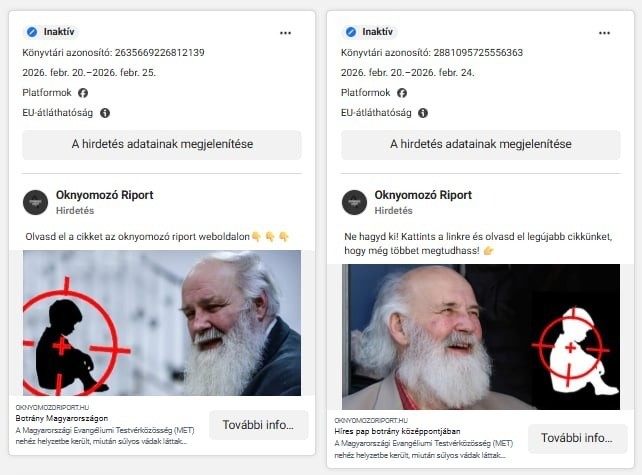
The question: who is behind this smear campaign? According to the Gnida Project, which monitors Russian disinformation campaigns, the methods clearly point to a Russian group called Storm-1516.
The Gnida Project’s analysis shows that this is not the first time that Hungarian opposition figures have been targeted by such disinformation campaigns.
In the past weeks, Péter Magyar has been at the centre of two disinformation campaigns. The method is the same in both cases: articles about corruption or other scandals are published on a supposed investigative site, without any proof or credible sources, and the content is amplified through social media, videos and ads.
Ban? What ban? 457 political ads in 6 weeks!
Political Capital conducted a thorough analysis of Meta’s political ads and found that
despite the ban, 457 political ads appeared in the first 6 weeks of 2026 from Fidesz and 2 opposition parties (Tisza and Democratic Coalition).
They monitored a total of 407 politicians and groups and concluded that the review of active and completed campaigns was delayed and was not comprehensive.
A group called 20K, which monitors the social media activity of politicians and political influencers, published its first analysis. They examined Facebook, Instagram and TikTok accounts in the 30 days before the official start of the campaign (20/01/2026 – 20/02/2026) and published some interesting data. Among other things, they found that Péter Magyar posted way less than Viktor Orbán, yet received twice as many reactions as Orbán.

How centralised are Tisza’s social media messages?
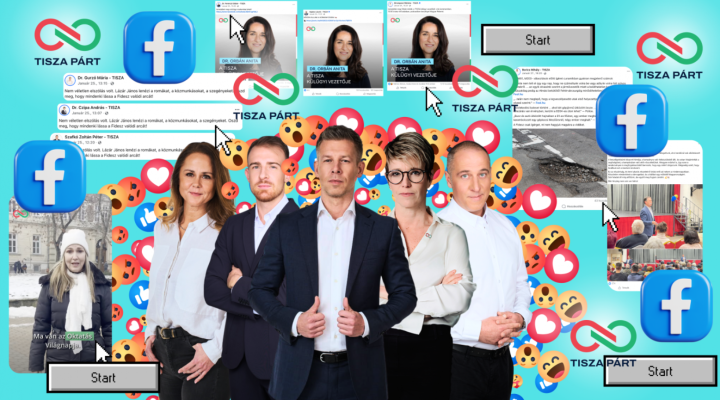
Tisza’s communication is quite centralized, with Péter Magyar clearly being the most frequently quoted person in the party. We were curious to see how centralized their social media communication is and whether they post the same things as Magyar. So, we looked at the candidates with the most followers on Facebook for a week at the end of January. Our main finding can be summarized as follows:
all accounts posted the main messages, often using the exact same words as Magyar, but when the topic was more general, they used local examples to tailor the message to their own area.
Péter Magyar loves to talk about that so many Hungarians have left the country that a big chunk of Hungarian babies are born abroad. When we checked this claim, we found that it’s basically impossible to say exactly how many Hungarian babies are born abroad, but also, it cannot be attributed to those who have left the country, because the statistics also include dual citizens who live outside of the country anyway.
Use of AI in the campaign
In our latest weekly digest, we wrote about how an online website closely associated with the socialist opposition party, Democratic Coalition had also started using AI to create videos. This trend seems to be continuing: Political Capital found a suspicious Facebook page that distributed AI-generated videos in the campaign of one of the Democratic Coalition’s candidates, discrediting the candidate from Tisza in one electoral district. And yes, this was also being run as a political ad. Who’s behind the shady page, we don’t yet know, but we are on it, so stay tuned for developments next week.
That’s all for today, see you next Friday. Share this article and tell us what you think!
Cover Photo: Annamari Dezső/Lakmusz