
Author: Lakmusz, member of HDMO
Until the elections in April, we closely monitor social media and traditional media, with a particular focus on disinformation related to the elections and false or misleading content spread by the candidates. This is our eighth weekly digest of the digital trends shaping the campaign period.
Russian disinformation goes deeper
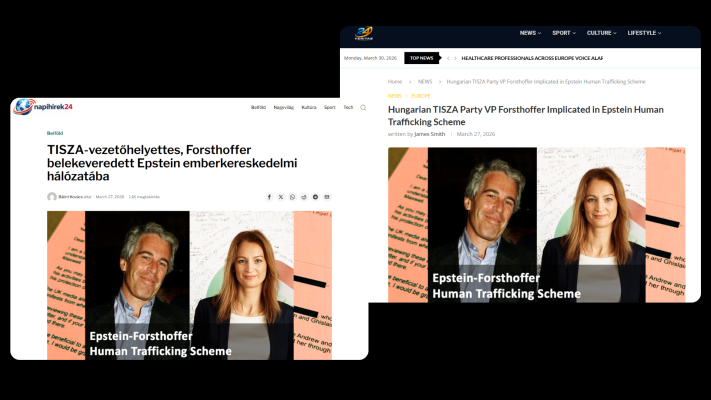
We didn’t have to wait long for another Russian disinformation campaign. Last week, we reported on an article published on a fake news site (and promoted via Facebook ads) that accused Romulusz Ruszin-Szendi, an opposition politician from the Tisza Party, and his cousin of recruiting Hungarian soldiers for the war; this week Russian disinformation is trying to discredit Ágnes Forsthoffer, vice president of the Tisza Party, by claiming she was involved in Jeffrey Epstein’s human trafficking network.
An article and a video posted on a fake website present an email and other financial documents allegedly proving Forsthoffer’s connection to Epstein. The documents shown do indeed come from the Epstein files; we, too, found them: they have nothing to do with Hungary or any Hungarian entity.
The email was simply forged: the word “Hungarian” was added before the name Ágnes, whereas the original document states “New York.”
The Gnida Project, which tracks Russian disinformation campaigns, also reported on the operation, once again linking it to a Russian group known as Storm-1516. In all cases, the defamatory content was published on a website that appeared to be an online news portal. We found many telltale signs indicating that the site and the information published on it are fake.
Ukrainian statements presented as threats by pro-government media
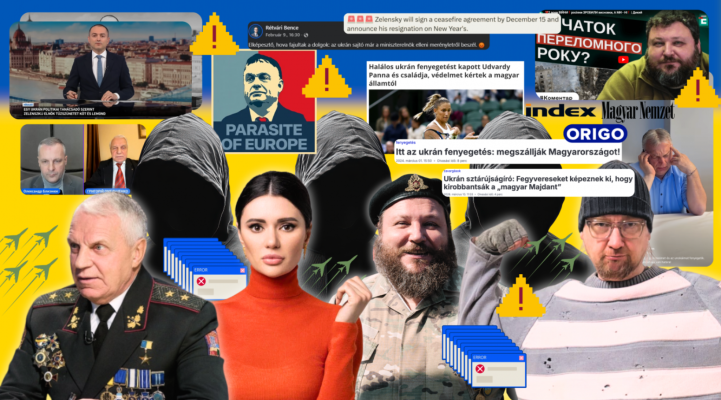
Diplomatic relations between Ukraine and Hungary have long been fraught with conflict, and the narrative of “Ukraine threatening Hungary” is a recurring theme in the government’s communications. It has also become an integral part of the election campaign.
On several occasions, the pro-government media and government figures have misleadingly presented various Ukrainian statements as threats coming from high-level sources. We have found examples of that dating all the way back to 2024. In our article, we have compiled seven such cases.
Some good old tactics to distort facts
In his recent speeches, Viktor Orbán has consistently claimed that there are 1 million more jobs today than in 2010 (when Fidesz came to power). Last time, he even claimed there are 1.1 million more. We’ve written about this matter several times, and each time we found that it’s not true: over the past 16 years, the number of jobs has increased by roughly 800,000.
One memorable moment of the campaign occurred in January, when Minister János Lázár remarked that Hungary’s Roma community served as a domestic reserve to “clean up the toilets after others on trains,” because “Hungarian voters aren’t exactly lining up to do that job.” Following this, Viktor Orbán bragged about how the government has helped the Roma people’s “rise to the middle class” by creating jobs for them. He depicted the economic and employment situation of the Roma people in a very positive light. We looked at some data, and, quite predictably, we did not find what he did.
In an article appeared in Mandiner, one of the flagships of the pro-government media, it was reported that Tisza politician István Kapitány wants to “make the Hungarian people foot the bill for the party’s energy transition plan.” In reality, drawing on an example from the United Kingdom, he spoke about how to finance the development of the power grid, which is necessary for the widespread adoption of electric cars. Well, that’s not entirely the same, is it?
Finally, in an interview with The Atlantic, Sándor Fegyir, Ukraine’s ambassador to Hungary, spoke about Russian interference in the Hungarian election, which, according to the ambassador, could even take the form of physical violence in the coming period. Fidesz politicians and pro-government media presented his words as if Sándor Fegyir had threatened Hungary with physical violence, or as if he had implied that the Ukrainians were planning such a thing.
Ahead of the Easter holiday right before the elections, we complied our fact-checks, in which we recently examined the false claims the political parties made as they worked to win over voters.
Before you go…
This week we published a brief which builds on the work of Lakmusz, and it summarizes the main disinformation themes and techniques we have observed in the campaign so far. It also outlines three important phenomena that affected the (dis)information ecosystem: the use of generative AI, the prohibition of political advertising by major social platforms, and foreign interference. Read it, use it, share it!
That’s all for today, see you next Friday. Stay tuned, share this article and tell us what you think!
Cover Photo: Annamari Dezső/Lakmusz