
AFP and Bellingcat: Combining OSINT and Field Reporting in Ukraine
The views expressed in this publication are those of the author and do not necessarily reflect the official stance of the European Digital Media Observatory. This text has been published as part of the second edition of the new monthly EDMO Signals & Noise newsletter. Sign up here to receive future editions directly to your inbox.
Over the course of the CEDMO 2.0 project, Bellingcat and AFP partnered to produce three long-form reports that combined open source and on-the-ground reporting.
AFP traveled to Ukraine three times, giving voice to Ukrainians on or near the front line while building a picture of events from the ground. Bellingcat, meanwhile, analysed publicly available data on landmines, social media footage as well as satellite imagery. This helped provide valuable information on some of the places it was too difficult or too dangerous for reporters to visit.
The quality of the outputs stand for themselves. All three reports are available here on the CEDMO website.
The reports focused on:
- The destruction of the city of Vovchansk (Bellingcat version and AFP version)
- The vast swathe of Ukrainian territory now polluted with landmines and unexploded ordnance (Bellingcat version AFP story and AFPTV video)
- The impact of Russia’s invasion and potential long term effects on Ukraine’s youth (Bellingcat version, AFP story and AFPTV video)
By combining on-the-ground reporting with an open source perspective, it was possible to tell a far more rounded and compelling story than would have been the case if both Bellingcat and AFP approached the same subject matter separately.
The resulting articles, videos and social posts received wide exposure and also took advantage of both organisation’s reach. Bellingcat published on its website and to its 700k X followers, 260k Bluesky followers, 100k LinkedIn followers, 80k newsletter subscribers, 60k Instagram followers and more. AFP published on its global newswire and video platforms that reach thousands of publications and their audiences of several million worldwide.
Along the way, some important lessons were learned that can help inform future EDMO projects, and which highlight the opportunity of combining on-the-ground, traditional reporting methods with those from the kind of open sources that Bellingcat specialises in.
There are many ways to obtain facts: AFP sent out reporters to speak to Ukrainians and collect information on the ground. Bellingcat turned to satellite imagery, publicly available but hard-to-find datasets as well as social media videos. By analysing satellite imagery gathered over Vovchansk, Bellingcat was able to put a precise figure on the number of buildings destroyed and what percentage of the town had been flattened.
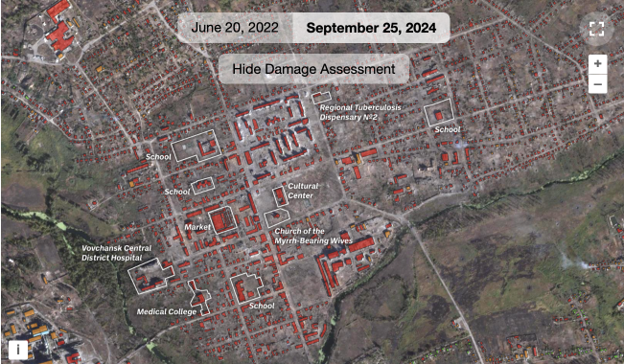
Given the ongoing fighting, it was not possible for reporters to go to Vovchansk. However, by visiting Kharkiv and speaking with refugees from Vovchansk, AFP was able to gather compelling personal testimonies from people who had fled their homes as well as lost neighbours and loved ones. AFP also gathered images and videos that were used to illustrate the story. All of this not only augmented the open source analysis and data but further brought it to life for readers.
Storytelling remains key: Bringing together these two very different reporting components created a powerful story. Data and analysis was given voice by the personal experience of residents. The experience of residents was quantified, visualised and given scale by the data analysis and satellite imagery.
Among the biggest challenges of news reporting is conveying information in a way that is both factually solid, enlightening and which resonates with the reader or viewer in a way that will stay with them. Combining open source and traditional reporting methods allowed both AFP and Bellingcat to create something that was powerful, objective, accurate and informative.
This mix of elements was something we repeated in the two stories that followed, on the impact of the war on Ukraine’s youth and the challenges of clearing landmines from Ukraine.
Visuals show all: Our second collaboration focused on how Ukrainian agricultural towns and villages were being impacted by landmines.
AFP visited several sites in Ukraine that had been impacted by the conflict and to which residents were returning, only to find landmines blighting the land they once lived and worked on. AFP spoke to residents and watched de-miners carry out their work, building a rich story with powerful quotes and pictures. Bellingcat used data from Ukraine’s National Mine Action Committee (NMAC) – which gathers data from 80 de-mining groups nationwide – to show exactly which pieces of land around the people who had been interviewed were mined.
Bellingcat then combined this information with data from Ukraine’s Ministry of Agriculture that detailed packages of land dedicated to farming activity. By combining the two datasets we were then able to see exactly how much farmland had been impacted by landmines in the areas the story focused on.
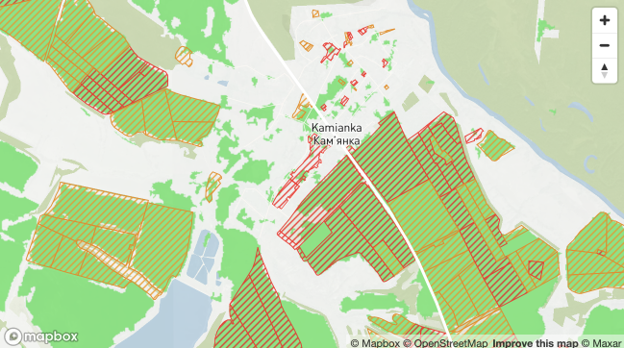
The visualisation we were able to create with this information provided a different kind of picture for readers about the dangers and challenges faced by many farmers returning to their homes, but specifically those who had spoken with AFP. This again provided a potent and powerful storytelling mix that we believe served readers and we hope stuck with them in a way that just the open source or traditional reporting on its own may not have.
Communication and collaboration: This was a genuinely constructive and respectful collaboration between two very different organisations. As heir to Agence Havas, AFP is the oldest news agency in the world, while Bellingcat is only 12-years-old. Each organisation has a particular expertise and skillset. Both of those complimented each other. But open communication and building a good working relationship was key in ensuring the outcomes we wanted were achieved. This meant regular calls, emails and engagement between both partners as well as an understanding of each other’s capabilities and limitations.
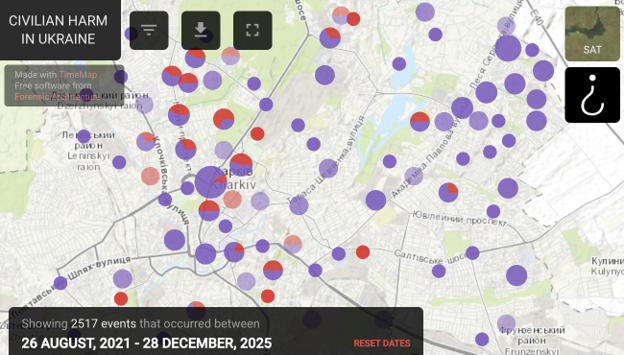
The importance of this communication was highlighted in the final collaboration that looked at the impact of the war on Ukraine’s youth. AFP again visited Kharkiv and spoke to residents on the ground while also visiting youth and education facilities that had been impacted by Russian airstrikes. Bellingcat had been gathering incidents of civilian harm and shared educational sites that had been impacted prior to AFP’s reporting trip. AFP, meanwhile, shared other potential sites and incidents with Bellingcat when there, allowing Bellingcat to add to its database of incidents.
Our final story saw AFP’s on-the-ground reporting once again combine with Bellingcat’s open source work, with testimonies from young Ukrainians interspersed with Bellingcat’s data detailing strikes that had impacted youth and educational facilities like kindergartens, schools and universities.
While collaboration is not necessarily new in journalism, combining traditional reporting with open source methods is still nascent. Strong communication helped ensure the outcomes were successful and that the blend of skills were channeled to produce a strong result.
It is important to reach the widest audience: With so much competition for attention, ever-altering social media algorithms and changing news habits, reaching a broad audience and having an impact is harder than ever. Audiences have more choice today, and they use it. Both AFP and Bellingcat combined to maximise the audience for these stories. Bellingcat has developed a large social media following and everything that goes out on our website is free. AFP has a different model that has served it very well and sees AFP coverage shared on its wire service to news organisations big and small around the world. These organisations then share the best and most suitable content with their audiences. The stories we produced hit both of these audiences and created a reach that is greater than would have been the case if AFP and Bellingcat had been operating independently.
What people want from journalism is changing: While the methods behind open source investigations have become an invaluable tool for fact-checking in recent years – rebuking disinformation, misinformation and all manner of nefarious actors – it can also produce valuable and revealing storytelling opportunities. This differs from traditional fact-checking and requires more resources to achieve. But when that is allied with traditional, on-the-ground reporting methods, the results can be powerful and storytelling opportunities are enhanced. This can offer more ways to engage audiences with news products that are appealing, informative and rich.

The three investigative reports on Ukraine were produced as part of project 101158609 co-funded by the European Union under the call DIGITAL-2023-DEPLOY-04. These reports reflect the views only of the independent Consortium, and the Commission cannot be held responsible for any use which may be made of the information contained herein.